
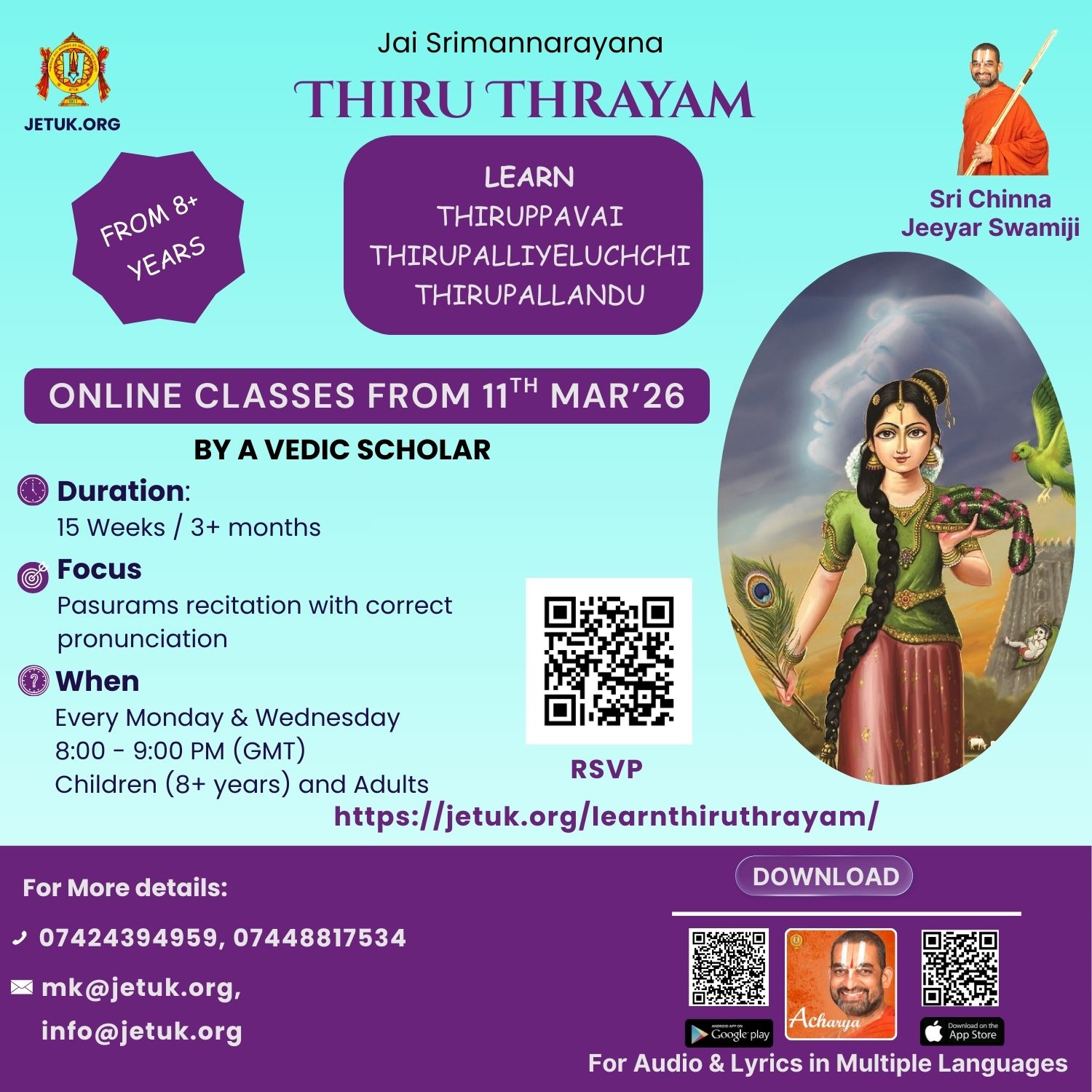
Thiru Thrayam – Online Classes
Jai Srimannarayana 🙏
A Sacred Journey Through ThiruThrayam (Thiruppallaandu , Thirupalliyeluchchi & Thiruppaavai)
What is Thiruppallandu ?
Thiruppallandu is a short devotional hymn composed by Periyalvar (Vishnuchitta), one of the 12 Azhwars (Tamil Vaishnava saint-poets). It consists of 12 verses and appears at the very beginning of the Nalayira Divya Prabandham, the sacred Tamil scripture of Sri Vaishnavism. The term “Pallandu” literally means “many, many years (of auspicious life).” The hymn is essentially a mangala-sasanam: a prayer wishing long life and eternal protection for Lord Vishnu.
What’s the significance of Thiruppallandu?
Unlike typical devotional hymns that focus on seeking blessings for oneself, Thiruppallandu uniquely expresses a devotee’s wish for the well-being and eternal protection of the Lord Himself. Periyalvar prays that Vishnu’s divine feet be protected for countless years, reflecting deep, selfless devotion. The hymn reflects Periyalvar’s profound emotional connection with Vishnu — he is so devoted that he almost behaves as a protector of the Lord when he fears that the Lord descending in the world (on Garuda) might be subjected to harm.
Why should we read Thiruppallandu?
It fills the mind with devotion and humility. Instead of merely focusing on personal desires, it turns the devotee’s mind toward surrender and love for the Lord. Thiruppallandu prepares the heart and mind for deeper engagement with sacred texts and worship. It is commonly recited at the start of worship services (nithya aradhanam) to invoke auspiciousness
When should I read Thiruppallandu?
It is traditionally recited at the start of temple rituals or personal prayers to invoke auspiciousness. Many Sri Vaishnavas include it in both at the beginning and end of worship. When preparing to read longer texts such as Divya Prabandham or other prayers, it is often read first.
What is Thirupalliyeluchchi?
Thirupalliyeluchchi is a set of 10 Tamil verses composed by Thondaradippodi Azhwar, one of the 12 Azhwars.
The word literally means “waking the Lord from divine sleep” (Palli = bed, Ezhuchchi = awakening). The hymn is addressed to Lord Ranganatha of Srirangam, requesting Him to awaken and bless the world.
What’s the significance of Thirupalliyeluchchi ?
he Azhwar lovingly urges the Lord to wake up and grant darshan, because:
- The world depends on Him
- Devotees are waiting for His grace
- The day’s divine activities (protection, teaching, blessing) should begin
Why should we read Thirupalliyeluchchi ?
The Azhwar does not command the Lord—he requests gently, showing the ideal devotee’s attitude: “I exist for Your service; please arise for our sake.”
Just as Suprabhatam prepares the Lord for the day, Thirupalliyeluchchi prepares the devotee’s mind:
- Clears tamas (laziness)
- Encourages sattva (clarity)
- Centers the mind on Bhagavan
By imagining the Lord resting, waking, smiling, and blessing devotees, the hymn builds intimate, loving bhakti, not distant or fear-based worship.
When should I read Thirupalliyeluchchi ?
Traditionally recited:
- Before sunrise
- During Brahma Muhurtham
- At the start of daily prayers
Many households recite:
- Thirupalliyeluchchi
- followed by Thiruppallandu
- then other Prabandham or stotras
What is Thiruppavai ?
Thiruppavai written by one and only women Azhwa:r Anda:l, in praise of Lord Vishnu consists of 30 Pasurams (verses). They aim at removing the effects of bad karma, shows us how to reach the holy feet of Supreme. Thiruppavai is said to be “Vedam Anaithukkum Vithagum” meaning seed of all Vedic Knowledge.
Thiruppavai, given to us by Andal for conducting our day to day activities, devotion, understanding the ultimate reality and attain Mukti (salvation). In just 30 verses dripping with melody, sweetness and profundity, I have learned many lessons which have a great impact on my daily life.
What’s the significance of Thiruppavai?
Goda devi came into this world to teach many values and principles that all of mankind should follow. Goda devi was sent to earth to teach some rules and ways people should follow to reach the lord. This was happening because of mankind’s ways. In the past God took many incarnations and forms to set people on the right path of life. But as hard as he tried, they weren’t listening or understanding. God was upset and Andal came to the earth to teach people, she taught us that how to love god. She also taught us that how to communicate with god himself. Andal always proved the lord in vaikuntam is same as in our home as archamurthi and same in our heart are the same being. To reach the Lord, she said to approach gurus. Goda Devis said we should follow 3 main rules while worshiping the lord.
- Always chant the lords name.
- Offer beautiful flowers.
- Finally, always be in Satsang.
Now that we know all the things Andal taught us, we should implement these in our daily life. We can use the 3 ways when we worship God. To worship God at home, at the temple, service to all beings as service to god.
Why should we read Thiruppavai?
Tiruppavai is recited in honour of Andal who imparted a lot of necessary knowledge to us in very simple language through the poem.
When should I read Thiruppavai?
Thiruppavai can be chanted on all days, not just during Margazhi, although “Chanting Thiruppavai during Margazhi does have a distinct charm. It is indeed a blessing to be able to sing in temples early morning.
Course details
- Duration: 15 Weeks
- Age Group: 8 years and above
- Mode: Online
- Course Fee: £75 (one-time payment – no instalments)
Class Schedule
- Day: Every Monday & Wednesday
- Timings: 8:00 PM – 9:00 PM (GMT)
Who can join?
- Children (8+ years)
- Youth and adults
- Beginners as well as continuing learners
- Anyone interested in learning the ThiruThrayam in a structured and authentic way
- No prior knowledge of the ThiruThrayam is required.
Focus Areas
- Taniyan and Pasuram(s) recitation
- Correct pronunciation
- Traditional Vedic learning methodology
Why join this course?
- Learn under the guidance of a Vedic scholar
- Well-structured learning spread across 15 weeks
- Focus on authentic pronunciation and discipline
- Suitable for individuals and families
- Convenient online learning from anywhere
Weekly Schedule
| Week 1 | Class 1 | 11 Mar 2026 | Guru Parampara: | 1-5 |
| Week 2 | Class 2 | 16 Mar 2026 | Thiruppalla:ndu Taniyans | 1-3 |
| Week 2 | Class 3 | 18 Mar 2026 | Pasurams | 1-3 |
| Week 3 | Class 4 | 23 Mar 2026 | Pasurams | 4-5 |
| Week 3 | Class 5 | 25 Mar 2026 | Pasurams | 6-7 |
| Week 4 | Class 6 | 30 Mar 2026 | Pasurams | 8-9 |
| Week 4 | Class 7 | 1 Apr 2026 | Pasurams | 10-11 |
| Week 5 | Class 8 | 13 Apr 2026 | Pasurams | 12 & Revision |
| Week 5 | Class 9 | 15 Apr 2026 | Thirupalliyeluchchi Taniyans | 1-2 |
| Week 6 | Class 10 | 20 Apr 2026 | Pasurams | 1-2 |
| Week 6 | Class 11 | 22 Apr 2026 | Pasurams | 3-4 |
| Week 7 | Class 12 | 27 Apr 2026 | Pasurams | 5-6 |
| Week 7 | Class 13 | 29 Apr 2026 | Pasurams | 7-8 |
| Week 8 | Class 14 | 11 May 2026 | Pasurams | 9-10 |
| Week 8 | Class 15 | 13 May 2026 | Thiruppa:vai Taniyans | 1-3 |
| Week 9 | Class 16 | 18 May 2026 | Pasurams | 1-2 |
| Week 9 | Class 17 | 20 May 2026 | Pasurams | 3-4 |
| Week 10 | Class 18 | 1 Jun 2026 | Pasurams | 5-6 |
| Week 10 | Class 19 | 3 Jun 2026 | Pasurams | 7-8 |
| Week 11 | Class 20 | 8 Jun 2026 | Pasurams | 9-10 |
| Week 11 | Class 21 | 10 Jun 2026 | Pasurams | 11-12 |
| Week 12 | Class 22 | 15 Jun 2026 | Pasurams | 13-14 |
| Week 12 | Class 23 | 17 Jun 2026 | Pasurams | 15-16 |
| Week 13 | Class 24 | 22 Jun 2026 | Pasurams | 17-18 |
| Week 13 | Class 25 | 24 Jun 2026 | Pasurams | 19-20 |
| Week 14 | Class 26 | 29 Jun 2026 | Pasurams | 21-22 |
| Week 14 | Class 27 | 1 Jul 2026 | Pasurams | 23-24 |
| Week 15 | Class 28 | 6 Jul 2026 | Pasurams | 25-26 |
| Week 15 | Class 29 | 8 Jul 2026 | Pasurams | 27-28 |
| Week 16 | Class 30 | 13 Jul 2026 | Conclusion |


